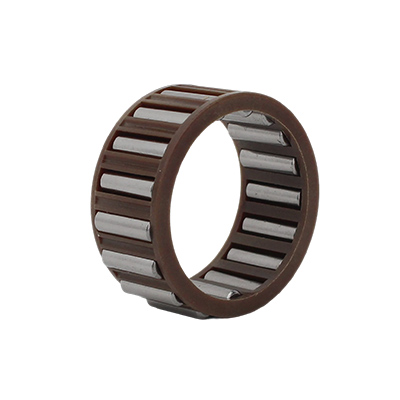

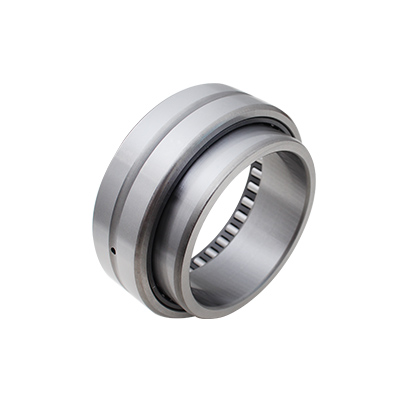
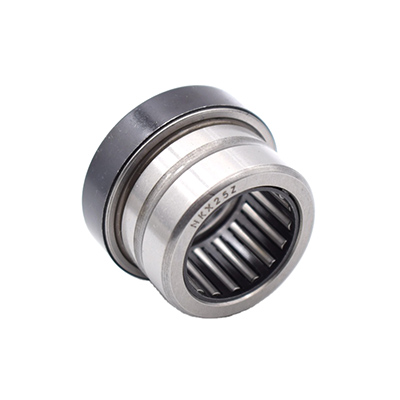
Needle roller bearings are a type of rolling bearing. Their core feature is that the rolling elements are slender cylindrical needles (length much larger than diameter), enabling them to provide high load-bearing capacity within an extremely small install...
Needle roller bearings are a type of rolling bearing. Their core feature is that the rolling elements are slender cylindrical needles (length much larger than diameter), enabling them to provide high load-bearing capacity within an extremely small installation space. They are widely used in mechanical scenarios with compact structures.
Core Structure and Working Principle
Structural Composition: Mainly consists of needle rollers, cages (some without cages), and inner rings (can be omitted, directly using the shaft or hole as the raceway). The structure is extremely simple with a minimal radial dimension.
Force-Bearing Principle: The needle rollers form line contact with the raceway, resulting in a large contact area. The load-bearing capacity per unit volume is far superior to other bearings of the same size, allowing it to withstand large radial loads.
Key Features and Advantages
Small Radial Dimension: The outer diameter is close to the inner diameter, saving installation space and adapting to components with strict size restrictions (such as gearboxes and connecting rods).
Strong Load-Bearing Capacity: The line contact design ensures stable performance under heavy loads and impact loads, suitable for high-load working conditions.
Flexible Adaptability: Can be used without inner or outer rings, directly utilizing the journal or housing hole as the raceway, reducing costs and simplifying the structure.
Typical Application Scenarios
Automotive Field: Compact transmission components such as gearboxes, clutches, connecting rods, steering systems, and wheel hubs (for small vehicles).
Industrial Machinery: Equipment requiring both space-saving and load-bearing capacity, such as reducers, compressors, machine tool spindles, and printing machinery.
General Machinery: Precision components needing a streamlined structure, such as small motors, power tools, and medical equipment.