Hub bearings are critical precision components in automotive and industrial wheel systems, serving as the interface between a vehicle’s stationary axle and rotating wheel. Their primary function is to facilitate smooth, low-friction rotation of the wheel while supporting axial and radial loads generated by the vehicle’s weight, road impacts, and driving forces. As integral parts of modern transportation, they directly influence driving safety, comfort, and mechanical efficiency.
Structurally, contemporary hub bearings typically adopt an integrated design, combining inner rings, outer rings, rolling elements (steel balls or tapered rollers), cages, and sealing assemblies. Unlike traditional split-type bearings, this integrated structure simplifies installation, reduces radial space occupation, and enhances overall rigidity. The sealing system, usually composed of rubber seals and grease, is vital—it prevents the ingress of dust, water, and road debris while retaining lubricant, significantly extending the bearing’s service life under harsh working conditions.
Key performance characteristics of hub bearings include high load-bearing capacity, wear resistance, and stability at high speeds. Tapered roller hub bearings excel in handling combined axial and radial loads, making them ideal for heavy-duty vehicles like trucks and buses. In contrast, ball-bearing based hub units offer lower friction and higher rotational speeds, suitable for passenger cars and light commercial vehicles. Precision manufacturing ensures minimal runout, avoiding wheel vibration and uneven tire wear.
Application-wise, hub bearings are ubiquitous across transportation and industrial sectors. In automotive industry, they are standard in passenger cars, trucks, motorcycles, and electric vehicles—electric models demand even higher precision to match motor efficiency. Beyond vehicles, they are used in industrial equipment such as agricultural machinery, construction vehicles, and conveyor systems, adapting to diverse load and speed requirements.
Maintenance of hub bearings is straightforward due to their sealed design, with most requiring only periodic inspections for abnormal noise or play. Timely replacement of worn bearings is crucial, as failures can lead to wheel seizing or loss of control. With advancements in materials like high-strength bearing steel and lubrication technology, modern hub bearings continue to deliver improved durability and performance, supporting the evolution of efficient and safe mobility.
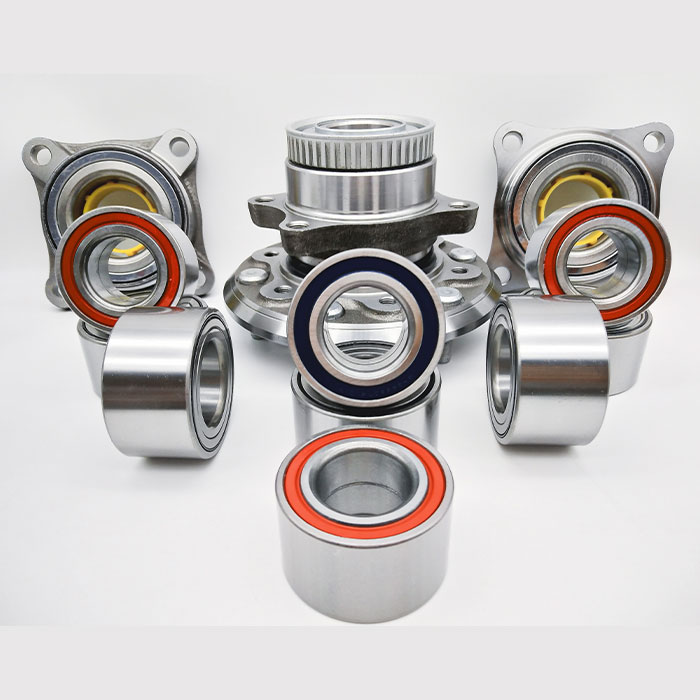
Full category product coverage.
Deeply rooted in the field of automotive bearings, our core products include a full range of bearings and supporting repair kits such as automotive wheel hub bearings, tapered roller bearings, deep groove ball bearings, etc. We provide one-stop solutions to meet the needs of vehicle matching, after-sales maintenance, special vehicle customization and other scenarios.